There are two guarantees in life that everyone talks about—death and taxes. I’d like to add a third: certification documentation requirements will continue to grow.
If you’ve worked in NDT for any length of time, you’ve probably noticed that audits have evolved over the years. What was acceptable ten years ago may not even pass an internal review today. That’s especially true when it comes to documenting the experience required for certification under NAS 410.
As I’ve mentioned in previous blogs, the NADCAP NDT Task Group meets several times each year to review audit findings. Those meetings include PRI Staff Engineers, subscribers, and industry representatives who discuss trends, recurring findings, and areas where additional clarification is needed. Many of the expectations auditors enforce today begin with those discussions.
A Story from a NADCAP Meeting
Several years ago, while attending one of those meetings, I found myself having a beverage with a Level 3 from one of the major aerospace engine manufacturers. Like most conversations between Level 3s, the discussion eventually turned into “you won’t believe what I saw on my last audit.”
He told me about auditing one of his suppliers and asking to see the experience documentation for an inspector who had recently been certified.
The supplier’s Level 3 calmly walked over to a filing cabinet, pulled out a blank OJT form, and began filling it out right in front of the auditor. He wrote in consecutive dates, entered eight hours for each day, totaled the hours until he reached the required experience, signed the form, and handed it back.
“There you go,” he said. “Here’s his OJT documentation.”
Needless to say, that didn’t end well.
The supplier received a finding for failing to adequately document on-the-job training. While I don’t know what corrective actions ultimately followed, the story didn’t end with that audit.
One Audit Changed Expectations
The incident sparked a lengthy discussion within the NADCAP Task Group about what actually constitutes acceptable experience documentation.
The conclusion was clear.
Recording dates and hours alone is not enough. Auditors want evidence that the experience actually occurred and that it was relevant to the certification being granted.
That means experience records should document things such as:
- The dates and qualifying hours worked.
- The specific inspection activities performed.
- The parts or product families inspected.
- Any training modules or procedures completed.
- The qualified individual who observed or verified the work.
In other words, the documentation should tell the story of how the experience was gained—not simply state that it happened.
And here’s another detail that surprises many organizations: an eight-hour workday does not necessarily equal eight hours of qualifying experience. Lunch, breaks, meetings, and other non-productive time often reduce the actual experience credited toward certification.
The Problem with Traditional OJT Records
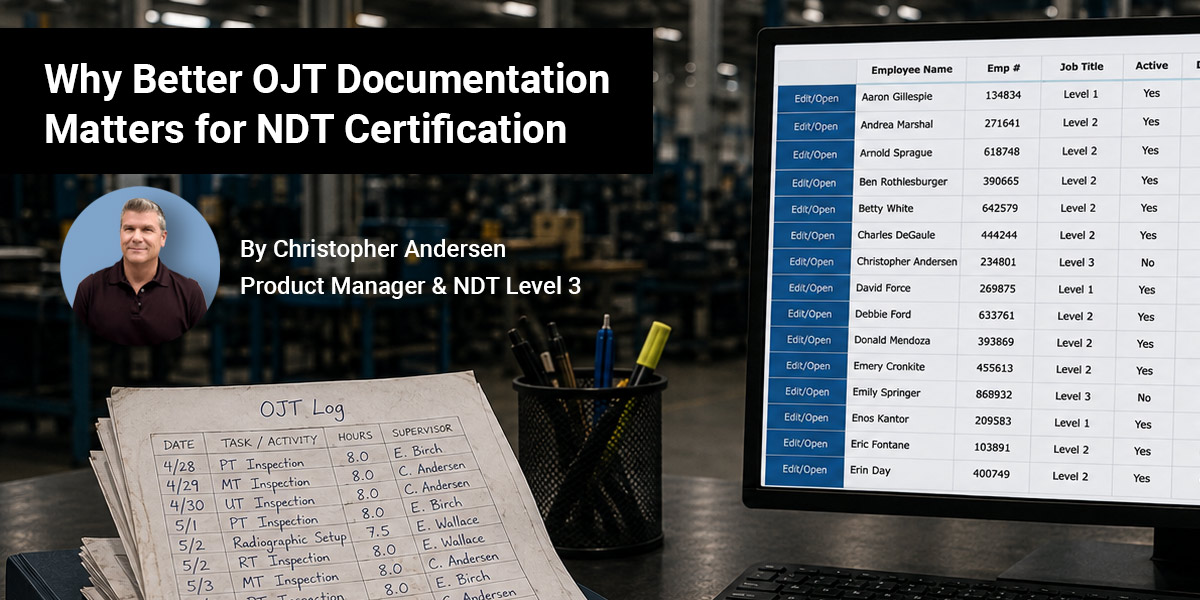
Unfortunately, many organizations still rely on handwritten OJT forms or spreadsheets to track experience.
I’ve watched auditors spend considerable time manually adding experience hours to verify they meet the requirements. Then they have to decipher handwriting, determine whether signatures are legible, and figure out exactly what work was performed.
If an “8” looks like a “6,” or no one can identify who signed the form, you’ve created questions that didn’t need to exist.
None of those issues improve the quality of the inspection process—they simply create unnecessary audit risk.
Documentation Is More Than an Audit Requirement
While satisfying auditors is important, organizations often overlook the operational value of good certification records.
Training an NDT inspector is a significant investment. Experience takes months—and sometimes years—to accumulate. During that time, management is constantly asking questions like:
- How many inspectors are currently certified?
- Who is still in training?
- How close are they to certification?
- Will we have enough qualified personnel to support production?
These aren’t audit questions. They’re business questions.
In many manufacturing environments, NDT is one of the final operations before product ships to the customer. If inspections become the bottleneck, the entire production schedule is affected. That’s when managers start looking to the Level 3 for answers.
Having accurate, up-to-date certification data makes those answers easy.
Let the Software Do the Work
This is exactly why we built DL QualityCore’s Training and Certification module.
Rather than relying on handwritten forms, spreadsheets, and manual calculations, DL QualityCore captures the information auditors expect while automatically calculating qualifying experience hours. Every training activity can include the task performed, the parts inspected, the supervising Level 2 or Level 3, and the supporting documentation needed to demonstrate compliance with NAS 410.
The result isn’t just cleaner audit records. It’s real-time visibility into your NDT workforce.
Managers can immediately see who is certified, who is progressing through training, and when additional inspectors will be available to support production. Level 3s spend less time chasing paperwork and more time managing the certification program.
Good documentation satisfies an auditor. Great documentation helps run the business.
About the Author
Christopher Andersen brings more than 45 years of experience in Non-Destructive Testing (NDT), with a career focused on aerospace inspection quality and certification compliance. As an NDT Level 3, he has led inspection programs, managed certification processes, and worked closely with auditors in complex manufacturing environments where accuracy and documentation integrity are critical. For over 20 years, he has been actively involved in NADCAP, developing deep expertise in AC7114 audits, NAS 410 certification requirements, and the responsibilities of Responsible Level 3 personnel.
Prior to joining ColumbiaSoft, Christopher served as Responsible Level 3 for Precision Castparts’ Large Structure Division, overseeing NDT certification programs across nine plants and more than 1,000 inspectors. This experience gave him firsthand insight into the challenges of managing qualification records, tracking renewals, and preparing for audits at scale. Today, as ColumbiaSoft’s NDT Level 3, he applies that expertise to the development of the DL QualityCore NDT Inspector Records Management Solution.