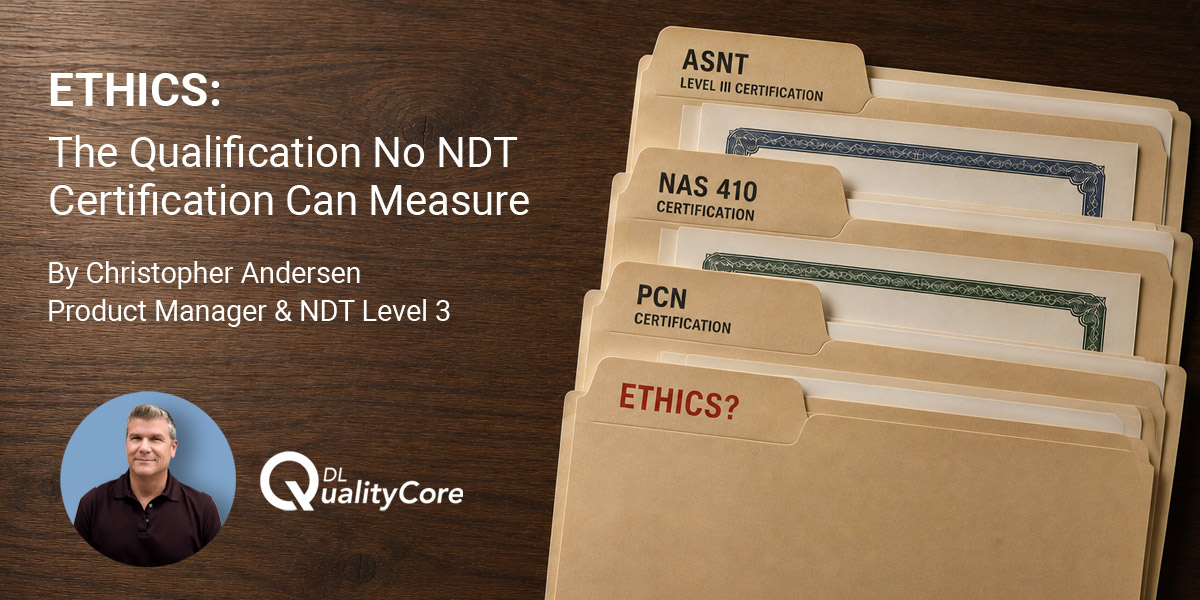
Over the years, I’ve often said that technical competence is only half of what makes a great NDT professional. The other half is something that no certification exam can truly measure: ethics.
In nondestructive testing, our decisions matter.
Missing a crack in a forged turbine disk, overlooking a defect in a fuel valve during radiographic inspection, or improperly performing an eddy current inspection on an engine mount isn’t simply a quality issue. Those mistakes can cost lives. If they happen because someone intentionally ignored procedures or falsified records, they aren’t just mistakes, they’re crimes.
A Lesson That Stayed With Me
Early in my career, I attended an ASNT conference on Digital Radiography. The first speaker wasn’t discussing technology or inspection techniques. He was talking about ethics.
He asked a question that has stayed with me ever since.
“How many of you have been asked to do something you knew was unethical?”
To my surprise, every hand in the room went up. Mine included.
Throughout my career, I’ve been pressured more times than I can count to ignore customer requirements, take shortcuts, or approve work that didn’t meet the contractual specifications. On more than one occasion, refusing to compromise my principles cost me my job.
Looking back, I wouldn’t change a thing. Jobs come and go but your integrity doesn’t. Ethical behavior takes decades to build and only seconds to destroy.
The Stories We All Share
Whenever Responsible Level 3s get together, the conversation inevitably turns into a collection of stories.
Some are funny. Many are unbelievable. A few are frightening.
I’ve heard stories of inspectors signing off entire X-ray film packets without ever examining a single radiograph. Others involved falsified certifications or inspection reports completed before the work had even been performed.
Fortunately, I also believe the NDT profession attracts people with an unusually strong sense of responsibility. Most of us tell these stories not because they’re common, but because they’re the exceptions that remind us why ethics matter.
One Unethical Decision Can Destroy Everything
One story has always stood out to me because it illustrates how far the consequences of a single unethical decision can reach.
A newly promoted Responsible Level 3 submitted an ASNT certificate to demonstrate compliance with the general examination requirements of NAS 410. After completing the company-specific requirements, he became the Responsible Level 3 for the facility.
For the next ten years, he approved procedures, certified inspectors, authorized work instructions, and oversaw the company’s entire NDT program.
Then someone discovered that the ASNT certificate he had submitted was forged.
Think about what happened next.
- Customers had to be notified.
- Every certification he had issued became questionable.
- Every procedure and work instruction he had approved was challenged.
- Years of inspections suddenly lost credibility because the individual responsible for the program had never been properly qualified.
- The company was forced to bring in another Responsible Level 3 to re-certify personnel, re-approve documentation, audit the system, and rebuild customer confidence.
One forged certificate threatened years of work and the reputation of an entire organization.
Today, Nadcap auditors routinely verify ASNT certifications directly with ASNT. That requirement exists because someone chose dishonesty over integrity. Unfortunately, every ethical failure in our industry seems to result in another layer of oversight, more documentation, and additional responsibilities for Responsible Level 3s. Rarely do requirements disappear. They only grow.
Why Responsible Level 3s Are Working Longer Hours
Several months ago, I wrote an article called Reducing the Pressures of the 55-Hour Work Week in NDT Leadership. Every time someone cuts a corner, falsifies a record, or ignores a requirement, our industry responds by adding another verification step.
- More documentation
- More audits
- More approvals
- More records
Most of those additional responsibilities land squarely on the shoulders of the Responsible Level 3. The unfortunate reality is that many highly qualified Level 3s now spend more time managing paperwork than observing inspections. That’s backwards.
Technology Can’t Create Ethics
People often ask me whether software can solve these problems. The answer is no. Software can’t prevent someone who intends to commit fraud. Ethics comes from character. What technology can do is remove the administrative burden that prevents ethical people from doing what they do best.
Imagine recovering hours every week because inspection reports, certifications, approvals, routing, filing, and expiration tracking happen automatically.
Those aren’t just hours saved. They’re hours that can be spent:
- Observing technicians in the inspection area.
- Auditing processes.
- Asking questions.
- Mentoring new inspectors.
- Recognizing when something doesn’t look right.
Experienced inspectors know how long an inspection should take. Cleaning, processing, dwell times, drying, equipment setup, and the inspection itself all require time. If someone claims to have completed the entire process in twenty minutes, that’s a conversation worth having. The paperwork shouldn’t keep you from having that conversation.
The Goal Isn’t Better Paperwork
At ColumbiaSoft, when we discuss DL QualityCore’s NDT records management solution, we often talk about automation, workflows, electronic records, and digital approvals.
Those are valuable tools, but they’re not the goal. The goal is giving Responsible Level 3s their time back.
When paperwork no longer consumes the day, they can focus on the responsibilities that truly protect customers, companies, and ultimately the public.
The Credential That Matters Most
After nearly five decades in this profession, I’ve learned that certifications, procedures, and technology are all important. But none of them matter if the person signing the report lacks integrity.
In the end, the most valuable credential you’ll ever hold isn’t printed on an ASNT certificate.
It’s the trust that your customers, your coworkers, and the public place in your name every time you sign an inspection report.
Frequently Asked Questions About Ethics in Nondestructive Testing
What can happen if an NDT certification or qualification record is falsified?
Can NDT software prevent unethical behavior?
How can better NDT records management support ethical inspection practices?
How can organizations support an ethical culture in NDT?
About the Author
Christopher Andersen brings more than 45 years of experience in Non-Destructive Testing (NDT), with a career focused on aerospace inspection quality and certification compliance. As an NDT Level 3, he has led inspection programs, managed certification processes, and worked closely with auditors in complex manufacturing environments where accuracy and documentation integrity are critical. For over 20 years, he has been actively involved in NADCAP, developing deep expertise in AC7114 audits, NAS 410 certification requirements, and the responsibilities of Responsible Level 3 personnel.
Prior to joining ColumbiaSoft, Christopher served as Responsible Level 3 for Precision Castparts’ Large Structure Division, overseeing NDT certification programs across nine plants and more than 1,000 inspectors. This experience gave him firsthand insight into the challenges of managing qualification records, tracking renewals, and preparing for audits at scale. Today, as ColumbiaSoft’s NDT Level 3, he applies that expertise to the development of the DL QualityCore NDT Inspector Records Management Solution.