A Small Oversight with a Big Impact
Most Responsible Level 3s don’t lose sleep worrying about catastrophic failures. More often, we worry about the little things, because in NDT, the little things have a way of becoming big things.
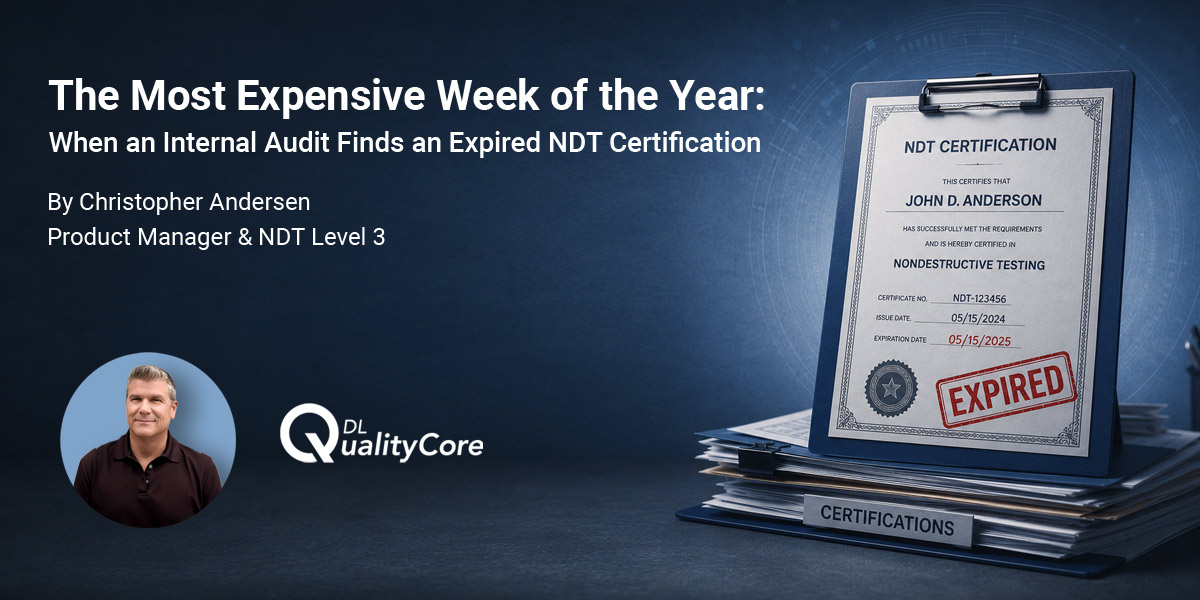
Consider a realistic example. An internal audit is underway, and the auditor pulls an NDT inspector’s certification record. At first, everything appears normal. Training records, eye examinations and experience records are all current. Then someone notices the certification expired seven days ago. Not six or even one month ago. Just seven days.
At first, management may think, “That’s not too bad.” But as Responsible Level 3s know, even a short lapse can create a much larger issue.
The Moment Everything Changes
The instant that expiration date is discovered, the conversation changes. The issue is no longer simply, “An inspector’s certification expired.” The issue becomes, “What inspections were performed during those seven days?”
Now the investigation begins. Quality needs to identify which jobs the inspector worked on, how many inspections were performed, what customers were involved, whether any product shipped, and whether any critical components were affected. Management wants to know whether re-inspection is required, whether a corrective action must be opened, and whether auditors will view this as a system failure.
What started as a seven-day lapse suddenly becomes one of the highest-priority issues in the building.
The Real Cost of a One-Week Lapse
The cost starts immediately. The Responsible Level 3 begins reviewing records. Quality starts tracing affected jobs. Production wants to know whether shipments are at risk. Management wants answers.
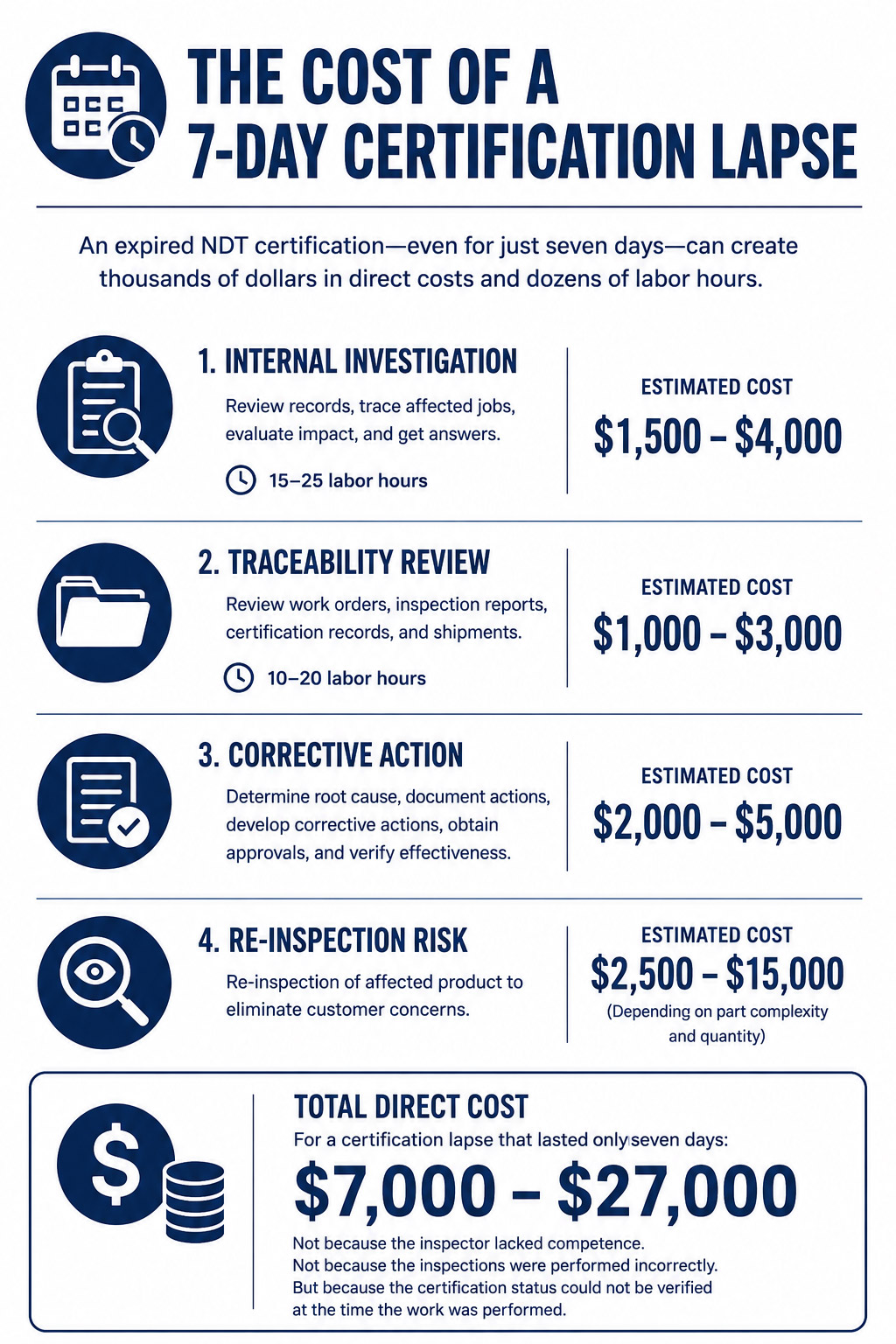
A typical cost breakdown may look like this:
- Internal investigation: $1,500–$4,000
Reviewing records, tracing affected jobs, evaluating impact, and coordinating answers. - Traceability review: $1,000–$3,000
Reviewing work orders, inspection reports, certification records, and customer shipments. - Corrective action: $2,000–$5,000
Determining root cause, documenting containment actions, developing corrective actions, obtaining approvals, and verifying effectiveness. - Re-inspection risk: $2,500–$15,000
Re-inspecting affected product, if needed, to eliminate customer concerns.
For a certification lapse that lasted only seven days, the total direct cost can quickly reach:
$7,000–$27,000
Not because the inspector lacked competence. Not because the inspections were performed incorrectly. But because the certification status could not be verified at the time the work was performed.
The Hidden Cost: Confidence
The financial impact is easy to calculate. The reputation impact is much harder. When leadership, auditors, or customers learn that an inspector performed work while uncertified, they usually do not question the inspector first. They question the process.
They ask:
- Why wasn’t this caught sooner?
- How many other certifications are approaching expiration?
- Can we trust the tracking system?
- Could this happen again?
- What is being done to ensure it never happens again?
One missed expiration date can create doubt about an entire certification management process. Even when the internal audit does its job and catches the issue before a customer audit or NADCAP audit does, the finding can still expand. If one certification expired unnoticed, auditors may reasonably wonder whether other records should be reviewed as well.
The Real Problem Is Usually Administrative
Certification lapses are rarely technical failures. More often, they are administrative failures. Many organizations still rely on a patchwork of manual tracking methods:
- Spreadsheets
- Email reminders
- Filing cabinets
- Shared folders
- Manual calendar alerts
These methods may work for a while, but every manual process eventually becomes vulnerable. Not because people are careless, but because people are busy.
Responsible Level 3s already manage procedures, training, qualifications, audits, customer issues, and technical oversight. Adding manual certification tracking to that workload creates unnecessary risk.
Creating Control Through Visibility
The good news is that certification lapses are largely preventable.
Organizations that rely on centralized NDT certification management software gain the visibility needed to stay ahead of expiration dates rather than discovering them during an audit. When NDT certifications, eye examinations, training records, experience documentation, and qualification records are maintained in a single system, Responsible Level 3s can quickly verify certification status and identify upcoming renewals across the organization.
Automated workflows and notifications further reduce risk by alerting supervisors, certification managers, and Responsible Level 3s before certifications expire. Reporting dashboards provide real-time visibility into certification status, helping organizations identify potential issues early and demonstrate process control during customer, internal, and third-party audits.
In this example, the lapse lasted only one week, yet it generated investigation costs, corrective action, audit concerns, customer questions, and doubt about process control. The lesson is not that the inspector failed. The lesson is that manual certification tracking creates unnecessary risk.
A centralized NDT certification management system transforms the process from reactive to proactive. Instead of scrambling to determine what happened after an expiration is discovered, organizations gain visibility into what is approaching expiration, who is affected, and what actions need to be taken. Automated reminders, centralized records, and reporting tools help ensure certifications remain current while providing the audit trail needed to demonstrate compliance.
That’s how a single date on a certification record stays a routine administrative task instead of becoming the most expensive week of the year.
Frequently Asked Questions About Expired NDT Certifications
What NDT records should organizations monitor for expiration or renewal?
Why are spreadsheets and manual reminders risky for NDT certification tracking?
How can NDT certification management software help prevent expired certifications?
How does centralized NDT certification tracking help during an audit?
About the Author
Christopher Andersen brings more than 45 years of experience in Non-Destructive Testing (NDT), with a career focused on aerospace inspection quality and certification compliance. As an NDT Level 3, he has led inspection programs, managed certification processes, and worked closely with auditors in complex manufacturing environments where accuracy and documentation integrity are critical. For over 20 years, he has been actively involved in NADCAP, developing deep expertise in AC7114 audits, NAS 410 certification requirements, and the responsibilities of Responsible Level 3 personnel.
Prior to joining ColumbiaSoft, Christopher served as Responsible Level 3 for Precision Castparts’ Large Structure Division, overseeing NDT certification programs across nine plants and more than 1,000 inspectors. This experience gave him firsthand insight into the challenges of managing qualification records, tracking renewals, and preparing for audits at scale. Today, as ColumbiaSoft’s NDT Level 3, he applies that expertise to the development of the DL QualityCore NDT Inspector Records Management Solution.